


Introduction to OLT Equipment
In all-optical campuses, FTTR (Fiber To The Room) whole-home fiber, operator gigabit broadband, and industrial weak current networking, the OLT is always the core hub. This article explains it in one go—from definition, architecture, and principles to selection, operation & maintenance, and application scenarios—so engineers in weak current engineering and networking can save it for reference.
1.What exactly is an OLT?
OLT (Optical Line Terminal) is the central office-side core equipment of a PON (Passive Optical Network). It is equivalent to the “brain” and central control unit of a fiber access network.
It connects upstream to the core switch / BRAS, and connects downstream to the ODN (Optical Distribution Network) (optical splitters + optical fibers), and finally connects to user-side ONU/ONT (optical modem), completing optical-electrical conversion, bandwidth scheduling, terminal management, and service forwarding.
Three key elements of a PON network
· OLT: central office core, responsible for control and scheduling
· ODN: optical distribution network, optical splitters + optical fibers (passive)
· ONU/ONT: user side, optical modem / remote module
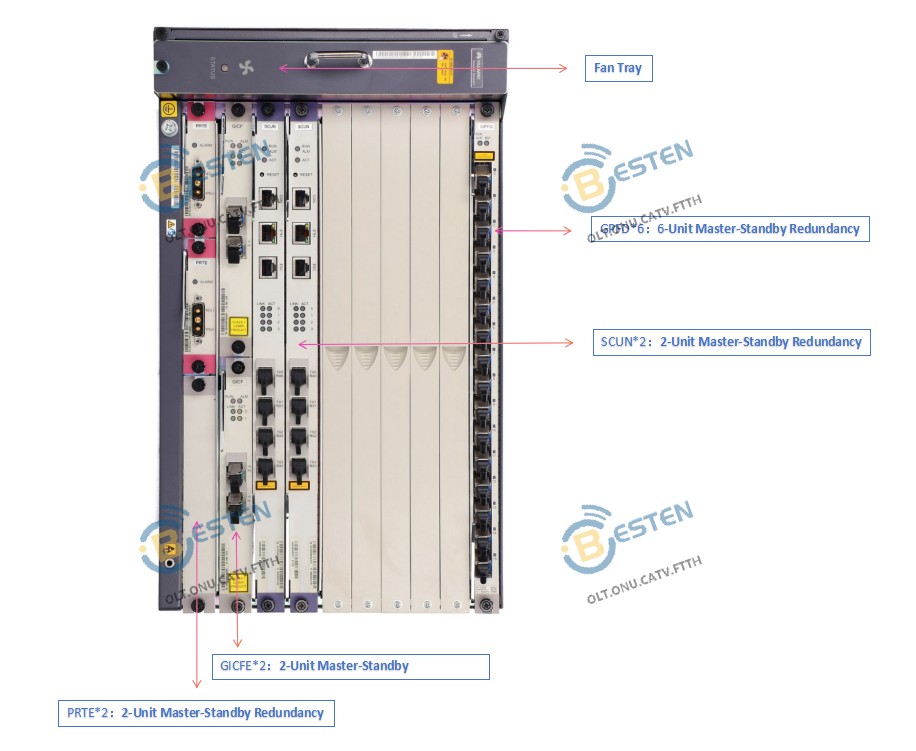
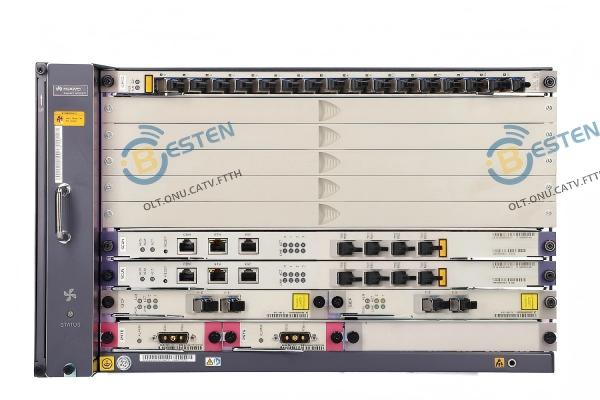
2.OLT hardware architecture: modular design is better for usability
Standard rack-mounted OLT adopts a plug-in card design, making it easier to expand and maintain.
Main control board: the core brain, responsible for protocol processing, configuration management, and fault monitoring.
Service board (PON board): provides PON ports, connecting downstream to optical splitters and ONU.
Uplink board: GE/10GE/25GE uplink ports, connecting to the core network.
Power supply board: dual power redundancy, ensuring no power outage.
Fan tray: heat dissipation, ensuring 7×24h stable operation.
Chassis: 19-inch standard rack, commonly 5U/10U/21U.
3.OLT core functions: not only forwarding, but also control and management.
(1)Optical-electrical conversion and signal scheduling.
It converts upstream electrical signals into optical signals and transmits them downstream via single-fiber point-to-multipoint broadcasting; it collects optical signals from the user side, converts them into electrical signals for upstream return transmission, so that a single fiber can serve an entire building at full capacity.
(2)ONU registration, ranging, and management.
Automatically discovers ONUs, performs logical registration and physical ranging to compensate for delay and avoid optical signal collisions; supports remote configuration, port switching, and status monitoring.
(3)DBA (Dynamic Bandwidth Allocation).
Intelligently schedules bandwidth based on service priority, prioritizing voice, video, and gaming to ensure they are guaranteed; no lag or congestion during peak hours.
(4)Security and QoS.
Supports port isolation, VLAN segmentation, ACL, and encrypted transmission; separates Internet, IPTV, and voice service channels so they do not interfere with each other.
(5) Protection and reliability.
Supports Type B/C optical fiber protection, dual main control redundancy, and power redundancy; automatic switchover in case of fiber break or failure, suitable for high-reliability scenarios such as hospitals, power plants, and data centers.
4.Comparison of mainstream PON technologies.
Home / general commercial use: GPON is sufficient
Enterprise / campus / 10G: XGS-PON is the first choice
New construction with long-term planning: directly deploy 50G-PON
5.OLT vs switch.
OLT: point-to-multipoint PON architecture, connected downstream to optical splitters, supporting a large number of ONUs; passive networking, fiber-saving, and easy to expand.
Switch: point-to-point electrical / optical ports, one link per terminal; more active devices and large cabling workload.
In a full-optical solution, using an OLT can simplify the traditional “core - aggregation - access” three-layer architecture into a two-layer architecture, reducing equipment by half, significantly reducing failure points, and making operation and maintenance easier.
6.Application scenarios: full coverage of weak current projects.
Operator broadband: FTTH (Fiber To The Home), gigabit / 10-gigabit fiber access to the home.
7.Key points for OLT selection
Port density: the number of PON ports (8/16/32 ports) matches the terminal scale
Uplink bandwidth: at least 10GE uplink to avoid bottlenecks
Split ratio: 1:64 / 1:128 adapts to the number of covered users
Protocol compatibility: supports OMCI, TR-069, and SNMP unified network management
Reliability: dual power supplies, dual main control, and optical fiber protection
Environmental adaptability: industrial-grade wide temperature range / dust protection for outdoor and harsh equipment room scenarios




Copyright © 2022 Besten telecommunicaition Techology Co., Ltd
All Rights Reserved




+86 18123800301
sales.besten0707@gmail.com