


What is the difference between OLT, ONU, and ONT?
We often see device terms like OLT, ONU, ONT, What are they respectively? And what are the differences?
PON components: OLT, ONU, ONT
Passive Optical Network (PON) uses optical fiber and splitters to distribute data from a single source to multiple users in a point-to-multipoint topology. Unlike Active Optical Network (AON), PON operates only in the optical domain without the need for electricity. The two main PON standards are Gigabit Passive Optical Network (GPON) and Ethernet Passive Optical Network (EPON). In an EPON (GEPON) system, components include the Optical Line Terminal (OLT) located at the provider central office, the Optical Network Unit (ONU) or Optical Network Terminal (ONT) located at the user endpoint, optical splitters (SPL), and the Optical Distribution Network (ODN) used to transmit data between the OLT and ONU/ONT.
What is OLT
The Optical Line Terminal (OLT) is a key device for transmitting signals in a fiber network. It is the starting point of a Passive Optical Network (PON) and is connected to the aggregation switch via Ethernet cable, playing a key role in the PON setup
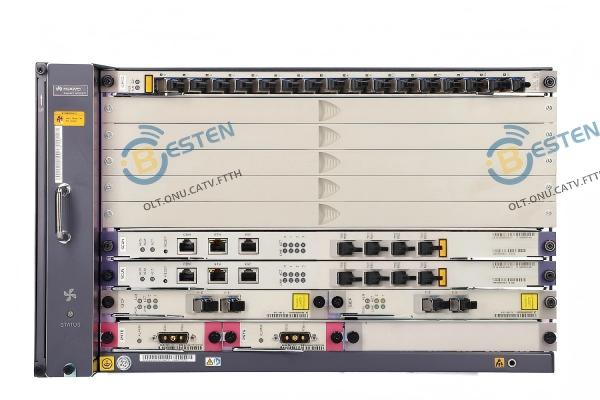
OLT Device Components
Typically, an OLT device includes a chassis, Control and Switch Module (CSM), EPON Link Module (ELM) (also called PON card), redundant -48V DC power modules or a single 110/220V AC power module, and fans. The PON card and power supply support hot-swapping, with another module integrated internall
y. OLT functions are divided into two directions: upstream (receiving and distributing various data and voice traffic from users) and downstream (receiving data, voice, and video traffic from the metropolitan or long-haul network and transmitting it to all ONT modules on the Optical Distribution Network (ODN)).
OLT Functions
OLT devices play a core role in Ethernet Passive Optical Networks (EPON). The OLT is a multifunctional platform that can support both IP services and traditional TDM services simultaneously. OLTs are usually located at the edge of a Metropolitan Area Network (MAN) or at the exit of a community access network, responsible for aggregating access services and transmitting them to the IP network. The EPON passive optical network system is very flexible, capable of connecting multiple terminals within a 20 km radius to build a network. This system can adapt to various business models, different working environments, and provide users with FTTx solutions.
In addition to service aggregation functions, the OLT can also act as a centralized network management platform, supporting device-based network element management, service-based security management, and configuration management, including monitoring and managing devices and ports, configuring services, monitoring user status, and allocating bandwidth according to Quality of Service (QoS) and Service Level Agreement (SLA) requirements.The main functions of the OLT also include broadcasting Ethernet data to the ONU, initiating and controlling the ranging process, and allocating bandwidth to the ONU, thereby controlling when the ONU sends data and the size of the transmission window.
OLT Applications
OLT devices work with various types of ONUs to establish diversified access networks such as FTTC, FTTH, FTTO, and FTTM. On one hand, they aggregate signals carrying various services at the central office and transmit them to end users through the access network in a specific signal format. On the other hand, signals from end users are routed to different service networks according to their service types. This configuration enables PON to serve multiple homes and provide various services such as IPTV, VOIP, and IP cameras.
What is ONT, what is ONU?
The main application types of broadband fiber access include: FTTH, FTTO, and FTTB. Under different application types, the user-side devices have different forms.
The user-side devices of FTTH and FTTO are for single-user use, called ONT (Optical Network Terminal). The user-side devices of FTTB are shared by multiple users, called ONU (Optical Network Unit). The term 'user' here refers to the operator’s independently billed user, not the number of terminals used. For example, an FTTH ONT is generally shared by multiple terminals within a home, but counts as only one user. Both ONT and ONU refer to user-end devices in fiber-to-the-home (FTTH) communication links. The ONU converts the optical signals transmitted through the fiber into electrical signals. These electrical signals are then sent to each user. Usually, there is a distance or other access network between the ONU and the end user’s premises.
Types of ONT
ONT (Optical Line Terminal), that is, the modem, is divided into SFU (Single Family Unit), HGU (Home Gateway Unit). BESTEN also sells these types of ONUs。http://www.bestentelecom.com/
SFU
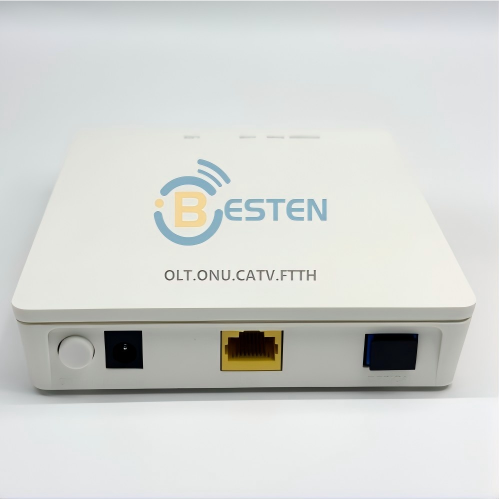
HGU
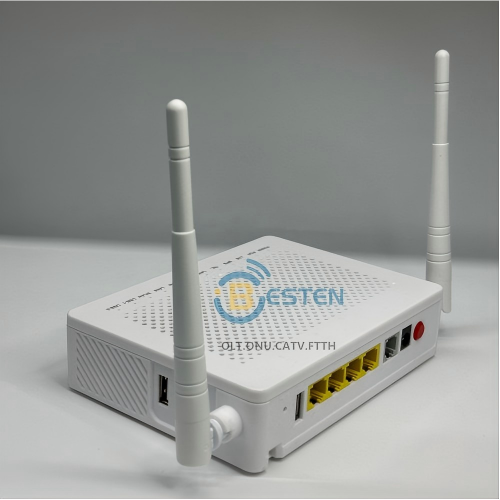
In recent years, the modems provided to FTTH users are all HGU, which generally comes with built-in WiFi and a USB port.
Mainly used for FTTO user access, generally with Ethernet interfaces, some models with E1 interfaces, fixed telephone interfaces, or WiFi functionality. Compared with SFU and HGU, SBU has better electrical protection performance, higher stability, and is also often used in outdoor scenarios such as video surveillance.
ONU Types
ONU (Optical Network Unit) is divided into MDU (Multiple Dwelling Unit) and MTU (Multiple Tenant Unit). MDU is mainly used for access of multiple residential users under the FTTB application type, generally with at least 4 user-side interfaces, usually 8, 16, or 24 FE or FE+POTS (fixed telephone) interfaces.
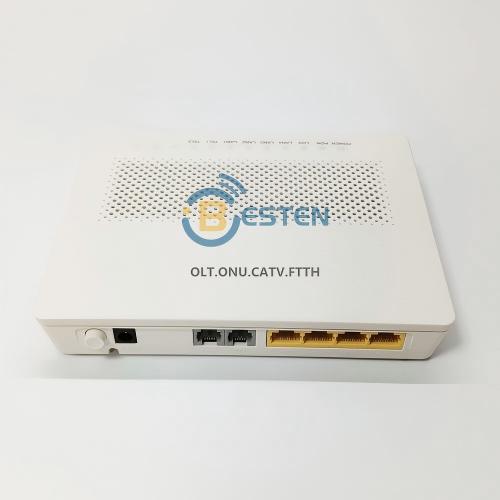
MTU is mainly used for access of multiple enterprise users or multiple terminals within the same enterprise under FTTB scenarios. In addition to Ethernet interfaces and fixed telephone interfaces, MTU may also have E1 interfaces. The appearance and functions of MTU are generally the same as MDU, but with better electrical protection performance and higher stability. With the popularity of FTTO, the application scenarios of MTU are becoming smaller.




Copyright © 2022 Besten telecommunicaition Techology Co., Ltd
All Rights Reserved




+86 18123800301
sales.besten0707@gmail.com